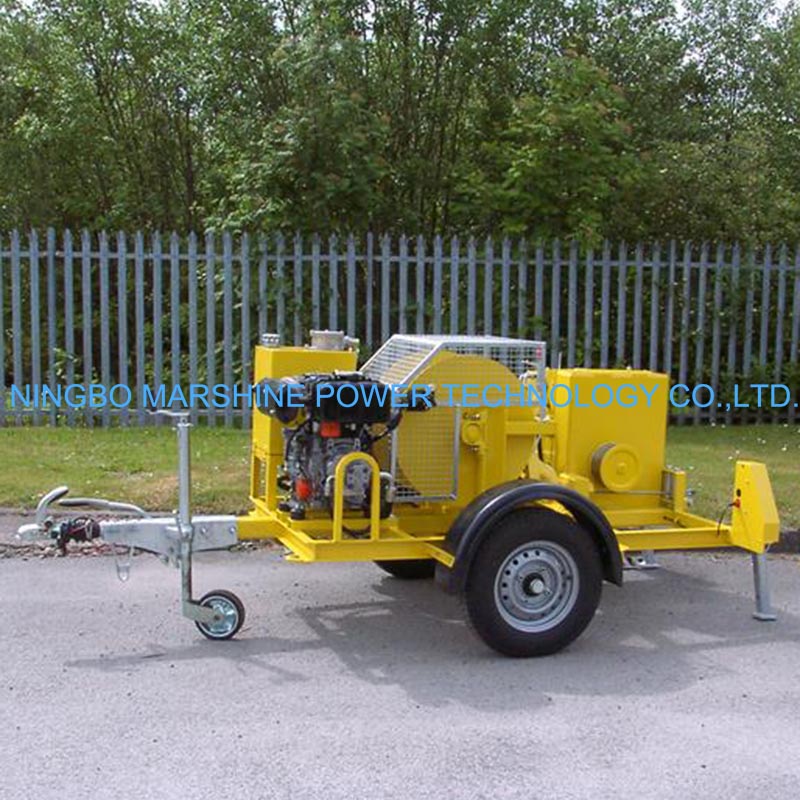
Hydraulic capstan winches are widely used in underground cable installation, duct cable pulling, utility construction, and infrastructure maintenance. Compared with conventional drum winches, a capstan winch provides continuous pulling capability because the rope passes around the rotating capstan instead of being stored on it. This allows virtually unlimited pulling distance while maintaining stable pulling performance.
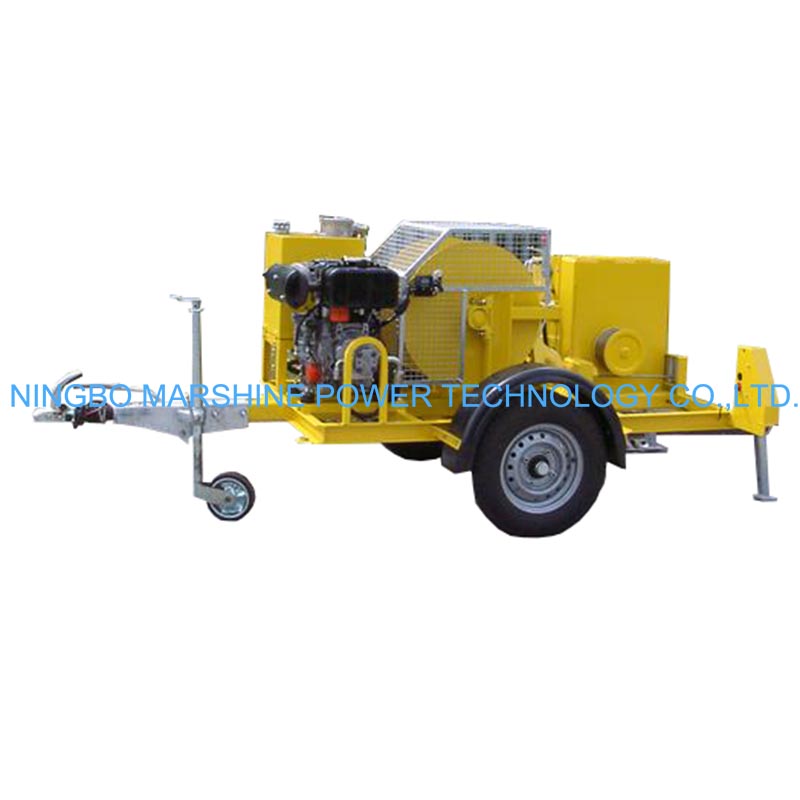
The MARSHINE MAR-CPW3000 Diesel Powered Hydraulic Capstan Winch is designed for demanding cable installation projects where controlled pulling force, smooth speed regulation, and reliable hydraulic performance are essential. Mounted on a road-towable trailer and powered by a diesel-driven hydraulic system, it delivers consistent pulling power for power cables, telecommunications cables, draw ropes, and other utility installation applications. Its systems are designed to provide a maximum line pull of 3,000 kg, hydraulic variable-speed control, and forward/reverse operation.
Understand the Working Principle of a Capstan Winch
Before operating the equipment, it is important to understand how a capstan winch differs from a conventional drum winch. Unlike a drum winch, the capstan winch’s rope is wrapped several times around the rotating capstan, the capstan can generates pulling force through friction, and the rope will continuously enters and exits the capstan. Because the rope is free to move continuously, the winch can handle long pulling distances without being limited by drum capacity.
So What Will Be The Key Point For Using It?
Anchor the Winch Securely
The MARSHINE MAR-CPW3000 Diesel Powered Hydraulic Capstan Winch can generates substantial pulling force.
Before starting any operation, please:
Park the trailer on firm, level ground.
Apply the trailer brakes.
Lower all stabilizing supports.
Connect the trailer securely to suitable anchoring points if required.
As the poor anchoring can reduce pulling efficiency and create unnecessary safety risks, a stable foundation is key to ensure that the pulling force is transmitted efficiently while preventing movement during operation.
Wrap the Rope Correctly Around the Capstan
Correct rope installation is one of the most important operating requirements.
The pulling rope should:
Follow the recommended wrapping direction.
Make the correct number of turns around the capstan.
Remain evenly spaced.
Stay free from twists or overlaps.
Too few wraps may reduce friction and cause rope slippage, too many wraps may make rope release more difficult and increase unnecessary friction. Proper rope routing allows the hydraulic capstan to maintain stable pulling force throughout the operation.
Select the Appropriate Pulling Rope
The pulling rope is a critical component of the system.
Always use:
Rope of the recommended diameter.
Rope with adequate breaking strength.
Clean, undamaged rope.
Rope compatible with the capstan surface.
Before every project, inspect the rope for:
Broken fibers or strands;
Cuts;
Abrasion;
Flattening;
Excessive wear;
Set the Correct Pulling Force
One of the greatest advantages of MARSHINE MAR-CPW3000 Diesel Powered Hydraulic Capstan Winch is its ability to provide controlled pulling force.
Before installation begins:
Determine the cable manufacturer's allowable pulling tension.
Adjust the hydraulic pressure or load control accordingly.
Verify the settings before pulling starts.
A controlled pulling force is particularly important when installing medium- and high-voltage power cables or fiber optic cables.
Maintain a Smooth Pulling Speed
Cable installation should always be performed with a consistent pulling speed. Please avoid the sudden acceleration, abrupt stopping, or rapid speed changes. The smooth operation offers several advantages:
Stable cable tension;
Better cable control;
Reduced mechanical shock;
Lower equipment wear;
Hydraulic speed control allows the operator to adjust the pulling rate according to the installation conditions, improving both safety and productivity.
Keep the Rope Properly Aligned
The pulling rope should enter and leave the capstan in a straight line whenever possible.
Poor alignment can result in:
Uneven rope wear;
Reduced friction;
Rope climbing;
Increased pulling resistance;
For this situation, using guide rollers and positioning the winch correctly will helps maintain smooth rope travel throughout the pulling operation.