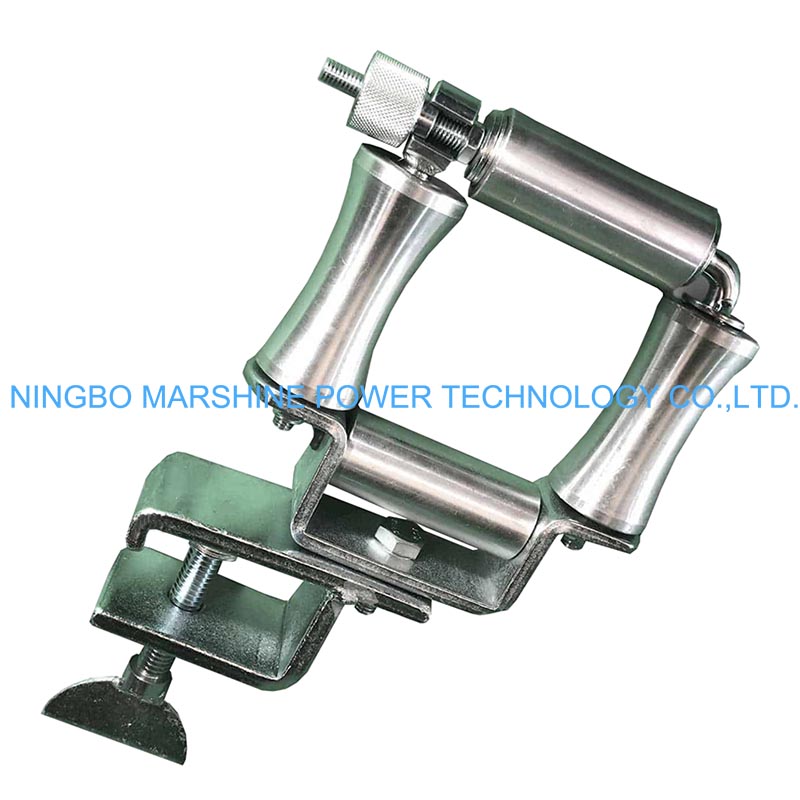
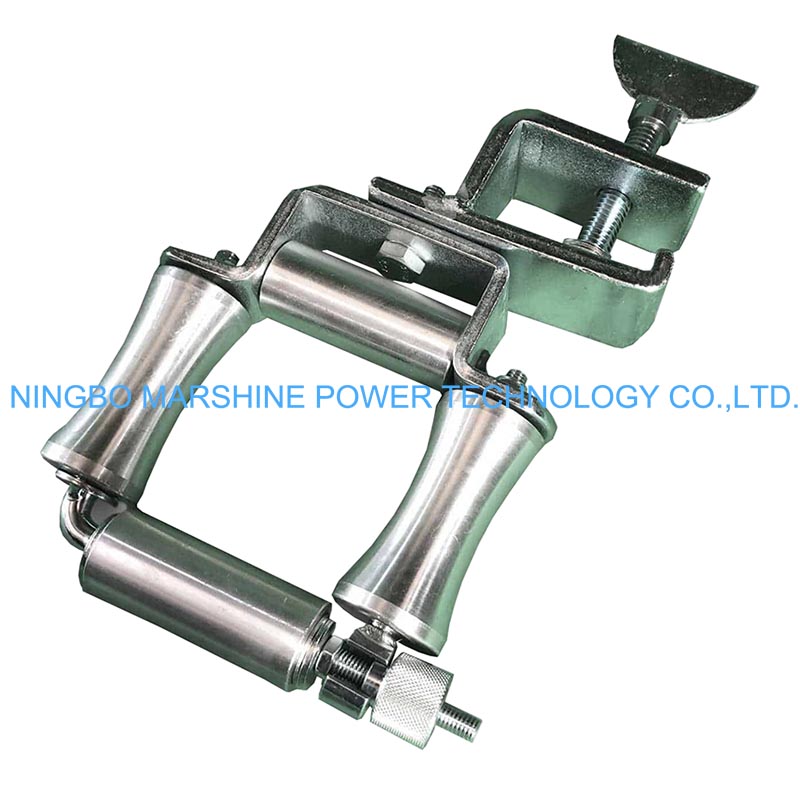
The MARSHINE MAR-HR4 Cable Tray Mounted Clamping Quadrant Roller is designed to solve this problem by providing smooth cable guidance around bends and directional changes. It features a tool-free clamping mechanism that securely attaches to cable trays, beams, or racks without drilling or welding. If required, the clamp can also be removed, allowing the roller to be permanently bolted onto Unistrut channels, cable trays, or other support structures. Equipped with two steel diablo rollers, two parallel guide rollers, a hinged gate with a knurled locking nut, and sealed precision bearings, the MARSHINE MAR-HR4 Cable Tray Mounted Clamping Quadrant Roller ensures smooth cable movement while protecting the cable from excessive wear. It is suitable for cables up to 60 mm in diameter and supports loads up to 100 kg.
So How To Use It Properly?
Inspect the Roller Before Installation
Before every project, inspect the MAR-HR4 carefully. Check the following:
Zinc-plated frame for cracks or deformation.
Clamping mechanism for proper operation.
Hinged gate for smooth opening and closing.
Knurled locking nut for secure tightening.
Rollers for free rotation.
Bearings for smooth movement.
Fasteners for tightness.
Roller surfaces for excessive wear.
The sealed precision bearings are designed to provide smooth operation with minimal maintenance, but regular inspection helps ensure reliable performance.
Select the Installation Location
Identify the point where the cable needs additional guidance. The roller should be installed wherever the cable changes direction or where additional support is needed to reduce friction.
Clamp the Roller onto the Cable Tray
One of the major advantages of the MAR-HR4 is its quick installation. To mount the roller:
Open the integrated clamp.
Position the roller over the cable tray, beam, or rack.
Tighten the clamp securely by hand.
Confirm that the roller cannot move during cable pulling.
The clamp is designed to attach without tools, allowing installers to position or relocate the roller quickly as work progresses. For permanent installations, the clamping section can be removed so the unit can be bolted directly to Unistrut channels or cable trays.
Open the Hinged Gate
The MARSHINE MAR-HR4 Cable Tray Mounted Clamping Quadrant Roller incorporates a hinged gate that simplifies cable loading. To insert the cable:
Loosen the knurled locking nut.
Swing open the hinged gate.
Place the cable inside the roller assembly.
Close the gate.
Tighten the locking nut securely.
Unlike enclosed rollers that require the cable to be threaded through the frame, the hinged gate allows the cable to be loaded or removed quickly, reducing installation time.
Verify Cable Position
Before beginning the pull:
Ensure the cable rests correctly between the guide rollers.
Confirm the cable is centered.
Verify the cable does not contact the steel frame.
Check that the gate is fully locked.
Begin Cable Pulling
Connect the cable to the pulling equipment and begin pulling gradually. Maintain:
Smooth pulling speed.
Steady cable tension.
Correct cable alignment.
The two steel diablo rollers help keep the cable centered, while the parallel rollers provide additional guidance through bends and changes in direction. This combination reduces friction and helps protect the cable jacket during installation.
Avoid sudden acceleration or shock loading.
Monitor the Roller During Operation
Throughout the cable pull, observe:
Roller rotation.
Cable alignment.
Clamp stability.
Cable tension.
Roller contact points.
Stop immediately if:
The clamp becomes loose.
The cable leaves the roller groove.
The gate opens unexpectedly.
The cable rubs against the frame.
Excessive vibration occurs.
Continuous monitoring reduces the likelihood of cable damage and improves installation quality.
Remove the Cable
After the cable has reached its final position:
Stop the pulling equipment.
Release cable tension.
Loosen the knurled locking nut.
Open the hinged gate.
Lift the cable from the roller.
Close and secure the gate before storage.
The hinged design makes cable removal quick and convenient, especially when multiple rollers are used along the cable route.